The Question Nobody Asks Early Enough
Most businesses default to SaaS. It is fast to set up, has a monthly price tag that feels manageable, and someone else handles the servers. That works until it doesn't.
At some point, the monthly fees add up. The tool doesn't quite fit your workflow. You need a feature the vendor won't build. Your data lives on someone else's infrastructure and you can't export it cleanly. That is when the question surfaces: should we have built our own?
This article gives you a framework to answer that question before you are locked in.
Definitions
SaaS (Software as a Service): You pay a recurring fee to use software hosted by a vendor. Salesforce, HubSpot, Slack, Shopify. You get updates automatically. You share the platform with thousands of other customers. Customization is limited to what the vendor allows.
Custom Software: Software built specifically for your business. You own the code, control the infrastructure, and decide every feature. It costs more upfront but nothing per seat per month. You maintain it yourself or hire someone to do it.
Total Cost of Ownership: 5-Year Comparison
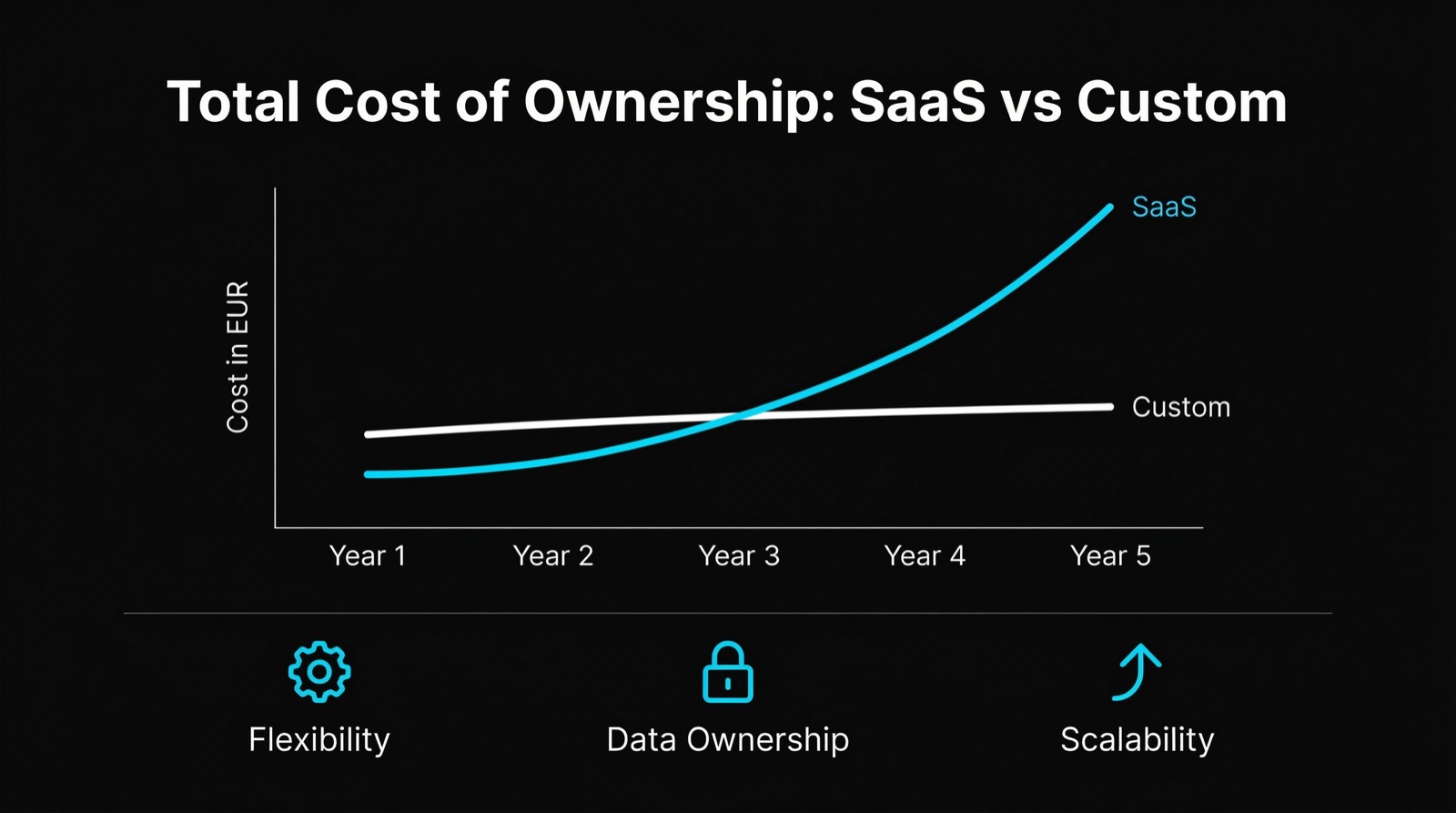
This is where most comparisons fail. They look at monthly cost vs. upfront cost and stop there. Real cost includes implementation, training, maintenance, opportunity cost, and what happens when you need to change.
| Cost Category | SaaS (5 years) | Custom Software (5 years) |
|---|---|---|
| License / Subscription | 25,000 - 150,000 (scales with users) | 0 (you own it) |
| Initial Development | 0 - 5,000 (setup/config) | 30,000 - 120,000 |
| Customization | 5,000 - 30,000 (plugins, integrations) | Included in development |
| Hosting & Infrastructure | Included in subscription | 3,000 - 15,000 |
| Maintenance & Updates | Included (but you have no control) | 10,000 - 40,000 |
| Training | 2,000 - 8,000 | 3,000 - 10,000 |
| Data Migration (exit) | 5,000 - 25,000 (often painful) | Not applicable (you own it) |
| 5-Year Total | 37,000 - 218,000 | 46,000 - 185,000 |
The numbers cross over around year 2-3 for most mid-sized deployments. SaaS is cheaper in year one. Custom software is cheaper by year five, especially if you have 20+ users paying per-seat fees.
When Custom Software Wins
1. Your Workflow Is Your Competitive Advantage
If the way you operate is what makes you better than competitors, forcing that workflow into a generic tool means giving up your edge. A logistics company with a proprietary routing algorithm should not try to cram it into a standard SaaS platform. The tool should fit the process, not the other way around.
2. You Need Full Data Ownership
In regulated industries (healthcare, finance, government), data sovereignty is not optional. With SaaS, your customer data sits on someone else's servers, often in another country. Custom software lets you choose where data lives, who accesses it, and how it is encrypted. GDPR compliance is simpler when you control the entire stack.
3. Per-Seat Pricing Is Killing You
SaaS tools that charge per user become expensive fast. A CRM at 50 per user per month costs 30,000 per year for a 50-person team. That is 150,000 over five years for software you don't own, can't modify, and will lose access to the moment you stop paying.
4. Integration Complexity Is High
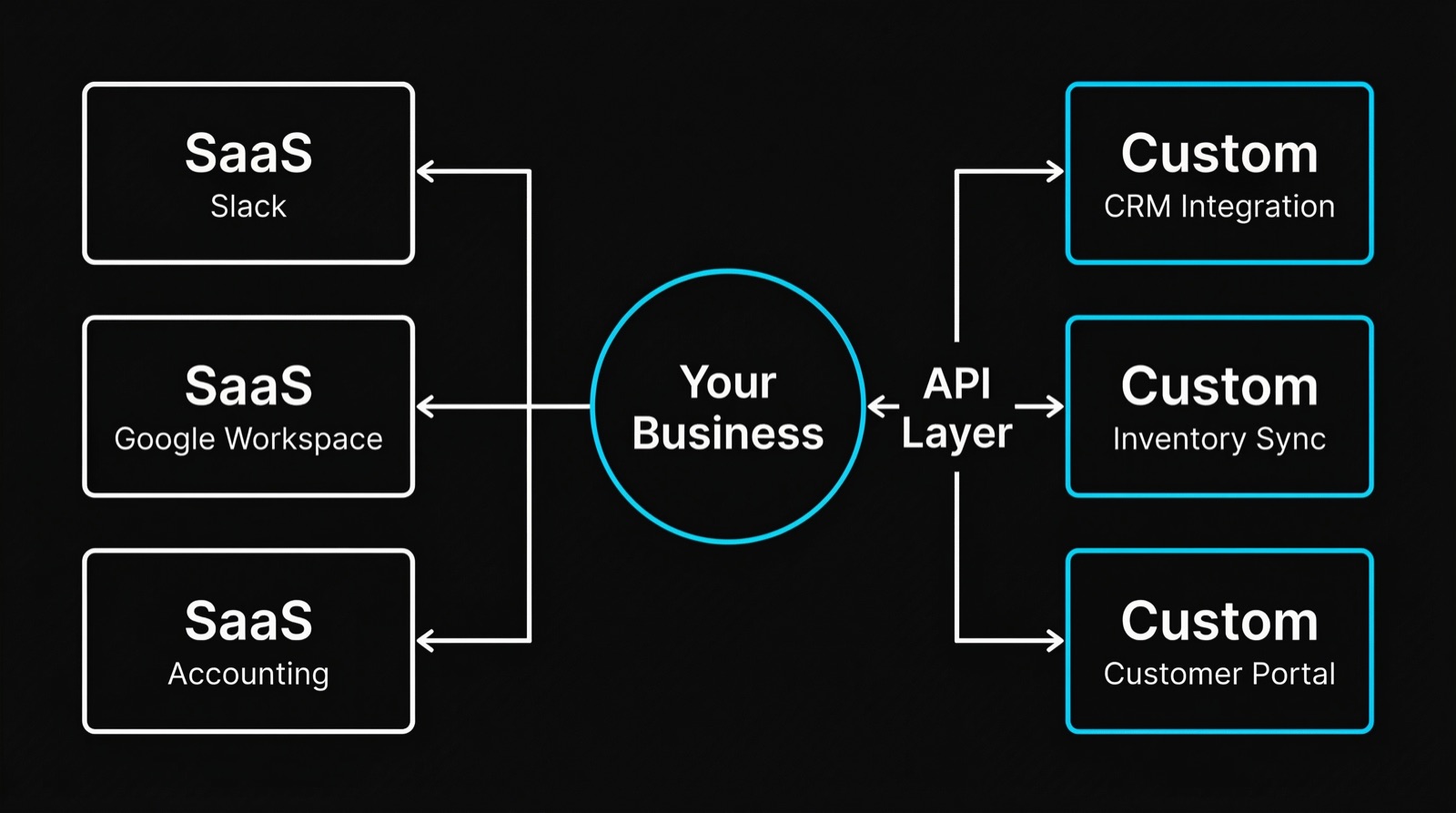
If you need to connect 5+ systems that were not designed to talk to each other, you end up building custom middleware anyway. At that point, you are paying for SaaS subscriptions and custom development. A purpose-built system with native integrations costs less in total and works better.
5. Vendor Lock-In Is a Real Risk
Switching SaaS providers is painful. Data formats differ. APIs change. Workflows need to be rebuilt. The switching cost is so high that many companies stay with tools they've outgrown simply because migration is too expensive. With custom software, you own everything. There is nothing to migrate away from.
When SaaS Wins
1. You Need to Move Fast
If you need a CRM running by next Monday, SaaS is the answer. Custom software takes weeks to months to build. SaaS takes hours to days. For early-stage companies or teams testing a new process, speed matters more than perfection.
2. The Problem Is Generic
Email, project management, basic invoicing, team chat. These are solved problems. Building your own Slack or your own QuickBooks is a waste of engineering time and money. Use SaaS for commoditized functions and save custom development for what makes your business unique.
3. Budget Is Tight and Upfront Capital Is Limited
SaaS spreads cost over time. 500 per month is easier to approve than 80,000 upfront, even if the total cost is higher. For businesses with limited capital or uncertain revenue, the subscription model reduces financial risk.
4. You Don't Have Technical Capacity
Custom software requires ongoing maintenance. If you don't have developers on staff or a reliable technical partner, SaaS vendors handle updates, security patches, and infrastructure for you. That is worth paying for if the alternative is software that breaks and nobody can fix it.
Decision Framework: 5 Questions
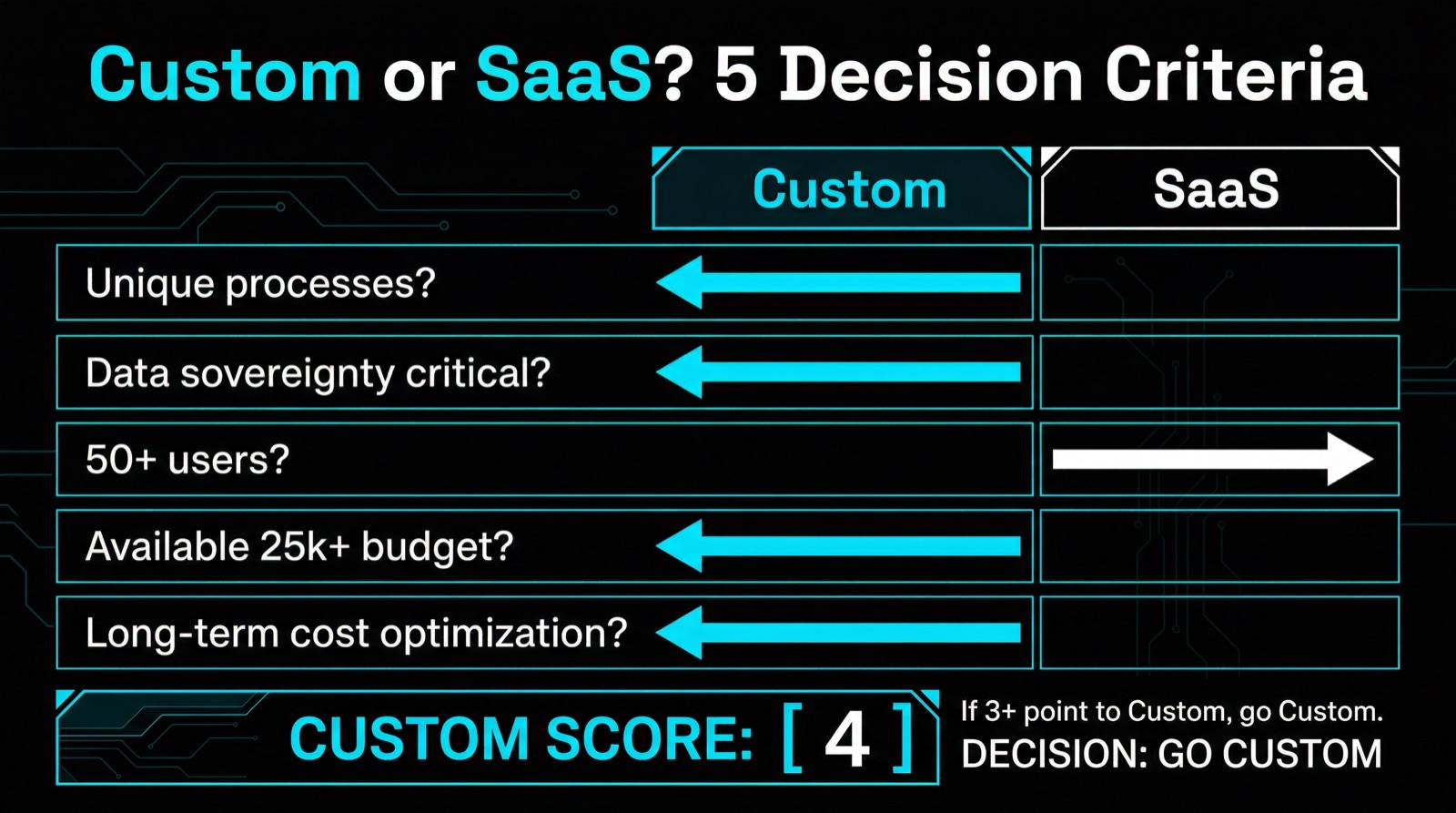
Answer these honestly. If you check 3 or more toward custom, it is probably worth the investment.
| Question | Points to SaaS | Points to Custom |
|---|---|---|
| How unique is your workflow? | Standard process | Proprietary / competitive advantage |
| How many users? | Under 15 | 20+ with per-seat SaaS costs |
| How sensitive is your data? | Low sensitivity | Regulated / highly confidential |
| What is your timeline? | Need it this month | Can invest 2-4 months |
| How long will you use it? | Under 2 years | 3+ years |
If your answers lean toward custom, the next step is scoping. Not a full build. A scoping session where someone maps your workflow, identifies the components, and estimates cost and timeline. We do exactly that at Webkomodo. Our custom systems service starts with understanding your process before writing a single line of code.
Key Takeaway
SaaS is the right choice for generic problems, tight timelines, and small teams. Custom software is the right choice for unique workflows, growing teams, sensitive data, and long time horizons.
The mistake most businesses make is defaulting to SaaS without running the numbers. When you add up 5 years of per-seat fees, integration costs, and the price of working around limitations, custom software often costs the same or less. And you actually own it. For a similar comparison in the web development space, see our article Custom Code vs WordPress.
Don't let the lower upfront cost of SaaS trick you into a higher total cost of ownership. Run the 5-year math. Then decide.
FAQ
At what company size does custom software make financial sense?
There is no hard cutoff, but the economics typically shift around 15-25 users. At that point, per-seat SaaS fees start compounding faster than the maintenance cost of custom software. A 20-person team paying 80 per user per month for a CRM spends 19,200 per year, or 96,000 over five years. A custom CRM built for that specific workflow might cost 50,000-70,000 to build and 8,000-12,000 per year to maintain, totaling 82,000-118,000 over five years. Below 10 users, SaaS almost always wins on cost.
How long does it take to build custom business software?
A focused MVP (minimum viable product) takes 4-8 weeks for most business applications: CRMs, internal dashboards, booking systems, or workflow automation tools. A full-featured system with integrations, reporting, and role-based access takes 2-4 months. The key is starting with the smallest useful version and expanding based on real usage data, not building everything at once.
Can I start with SaaS and switch to custom later?
Yes, and many companies do. The risk is data migration. Before committing to a SaaS tool, check three things: Can you export all your data? In what format? And does the vendor charge for it? Some platforms make exports easy. Others make it deliberately painful. If you plan to migrate eventually, document your workflows from day one and keep your data clean. That makes the switch from SaaS to custom 40-60% cheaper than starting the documentation process during migration.
Founder, Webkomodo
Ready for your project?
Let's find out how we can grow your business digitally in a free consultation.
Free consultation