Two Tools, One Goal
Every B2B website faces the same problem: visitors arrive, browse, and leave without talking to anyone. Live chat and chatbots both attempt to fix this by opening a conversation before the visitor disappears. But they work differently, cost differently, and convert differently.
Live chat connects visitors with a human agent in real time. A chatbot uses trained software to handle conversations automatically. Both sit in the same widget in the corner of your screen. The similarities end there.
This article compares the two on the metrics that matter for B2B lead generation: conversion rates, response speed, cost per lead, and scalability.
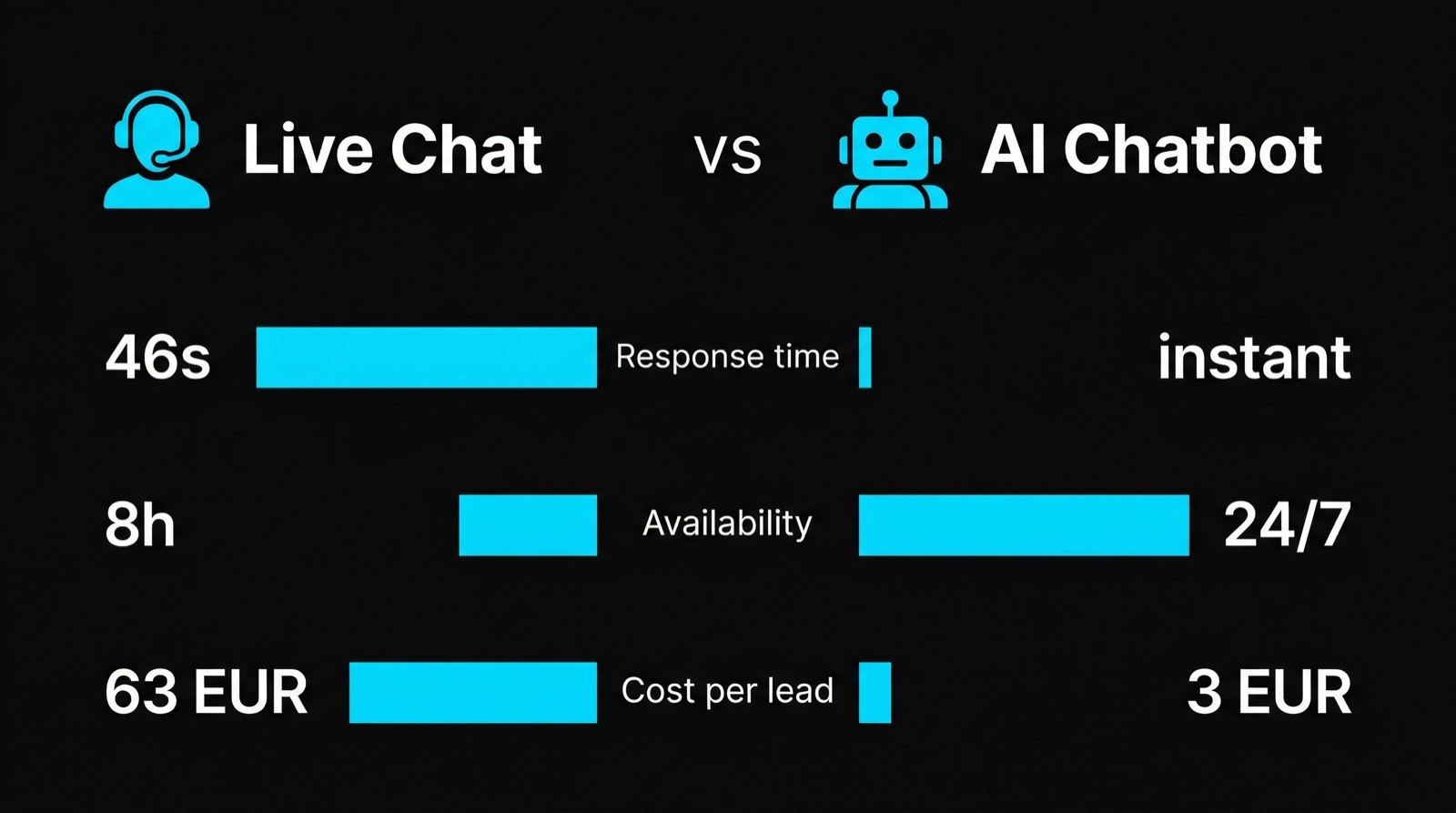
Head-to-Head Comparison
| Factor | AI Chatbot | Live Chat |
|---|---|---|
| Response time | Under 3 seconds | 45 seconds - 3 minutes (when staffed) |
| Availability | 24/7/365 | Business hours only (typically 8-10 hrs/day) |
| Cost per month | 200 - 1,500 EUR | 3,000 - 8,000 EUR (2-3 agents) |
| Cost per conversation | 0.50 - 2.00 EUR | 8 - 15 EUR |
| Simultaneous conversations | Unlimited | 2-4 per agent |
| Consistency | 100% (same qualification every time) | Variable (depends on agent, mood, training) |
| Personalization depth | High (behavior + data driven) | Very high (human intuition) |
| Complex objection handling | Moderate | Excellent |
| Lead qualification accuracy | 85-92% (rule-based) | 70-85% (human judgment varies) |
| Setup time | 2-4 weeks | 4-8 weeks (hiring + training) |
| Scaling cost | Near zero | Linear (each new agent = full salary) |
The table reveals a pattern: chatbots win on speed, cost, and consistency. Live chat wins on depth and nuance. The question is which of those advantages matters more for your specific situation.
The 5-Minute Rule: Why Speed Wins
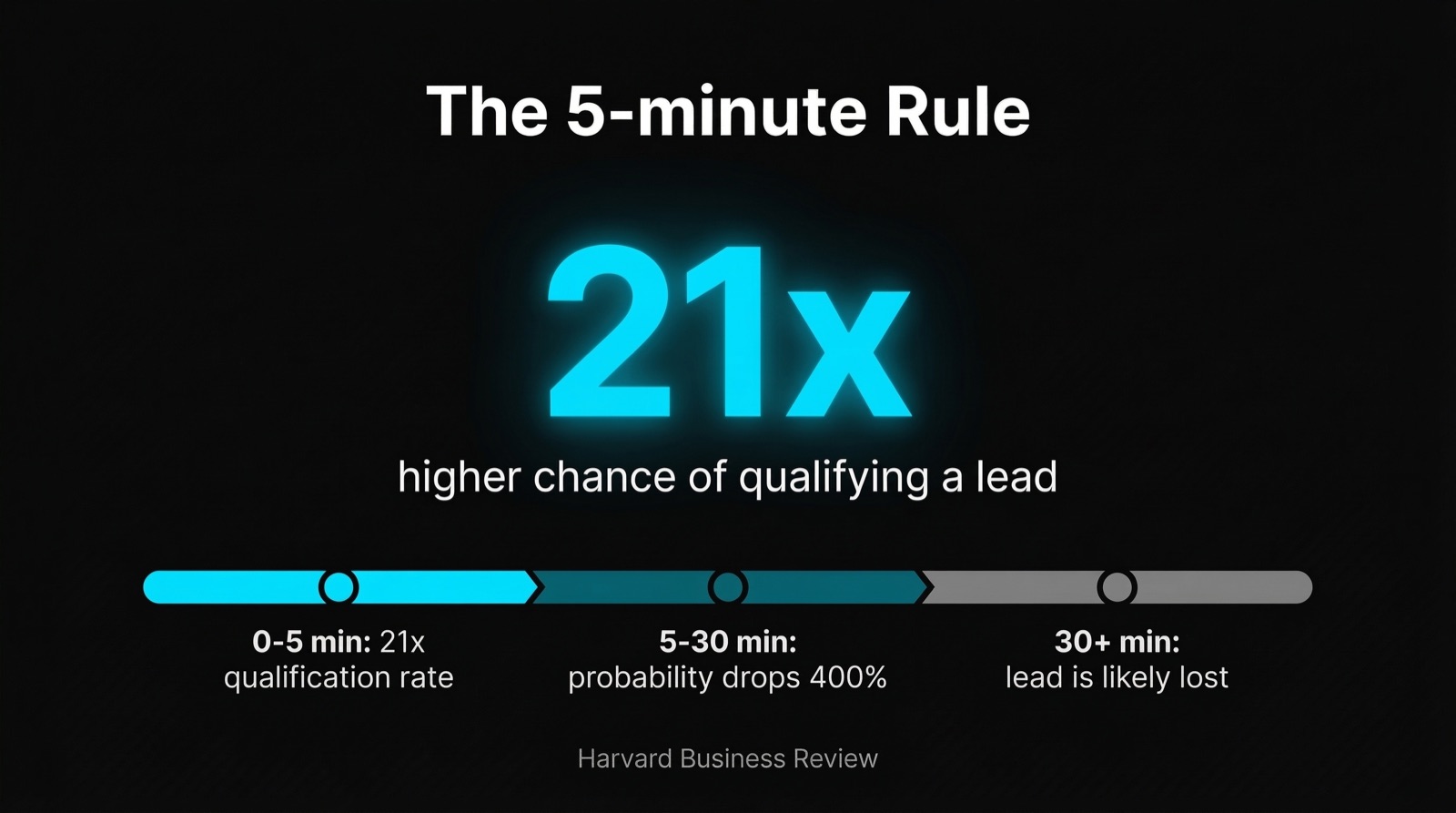
A study published in Harvard Business Review analyzed 2,241 B2B companies and found that firms contacting leads within 5 minutes were 100x more likely to connect with them compared to firms that waited 30 minutes. After 5 minutes, the odds of qualifying a lead drop by 400%.
This finding reshapes the entire chatbot vs live chat debate.
Live chat can be fast, when agents are available. But "available" is the operative word. The average B2B company staffs live chat for 8-10 hours per day, 5 days per week. That covers roughly 24% of the week. During the other 76% of the time, visitors see "Leave a message" instead of "Chat now."
Those off-hours are not dead time. Data from Drift's 2023 State of Conversational Marketing report shows that 27% of B2B website conversations happen outside standard business hours. On weekends. Before 8 AM. After 6 PM. Every one of those conversations is a potential lead that live chat cannot reach.
Chatbots do not have off-hours. They respond in under 3 seconds, every time, at 3 PM and at 3 AM. For the 5-minute rule, this is not a marginal advantage. It is the difference between capturing a lead and losing it permanently.
Conversion Data: What the Numbers Show
Across B2B websites, the data on chat-driven conversion is consistent:
- Websites with no chat: 1-3% visitor-to-lead conversion rate
- Websites with live chat: 5-8% conversion rate (during staffed hours)
- Websites with AI chatbot: 8-15% conversion rate (across all hours)
The chatbot advantage is not just about better conversations. It is about volume. A chatbot engages every visitor who shows interest, on every page, at every hour. Live chat engages a subset of visitors during a subset of hours.
Consider a B2B company with 3,000 monthly visitors:
- No chat: 60 leads/month (2% conversion)
- Live chat: 120 leads/month during staffed hours, near-zero outside them. Blended rate: roughly 90 leads/month
- AI chatbot: 300 leads/month (10% across all hours)
The chatbot does not convert better per conversation. It converts better per month because it never stops.
This is precisely the kind of pipeline impact that AI-powered lead systems are designed to deliver. The technology handles engagement, qualification, and booking in a single automated flow. For a deeper dive, see our complete guide on AI Lead Generation.
Cost Per Qualified Lead
For B2B companies, cost per lead is meaningless without "qualified" in front of it. A hundred form submissions from students and competitors is worse than ten real conversations with decision-makers.
Here is the cost breakdown:
Live chat team (2 agents):
- Agent salaries: 5,000 - 7,000 EUR/month total
- Software (Intercom, Zendesk, etc.): 200 - 500 EUR/month
- Training and management: 500 - 1,000 EUR/month
- Total: 5,700 - 8,500 EUR/month
- At 90 leads/month: 63 - 94 EUR per lead
AI chatbot:
- Platform cost: 500 - 1,500 EUR/month
- Setup and optimization: 200 - 500 EUR/month (amortized)
- Total: 700 - 2,000 EUR/month
- At 300 leads/month: 2.30 - 6.70 EUR per lead
The cost per lead difference is 10-40x. Even if you adjust for qualification accuracy (chatbots at 90%, humans at 80%), the AI system produces more qualified leads at a fraction of the cost.
The Hybrid Approach: Best of Both
The best-performing B2B websites do not choose between chatbot and live chat. They use both.
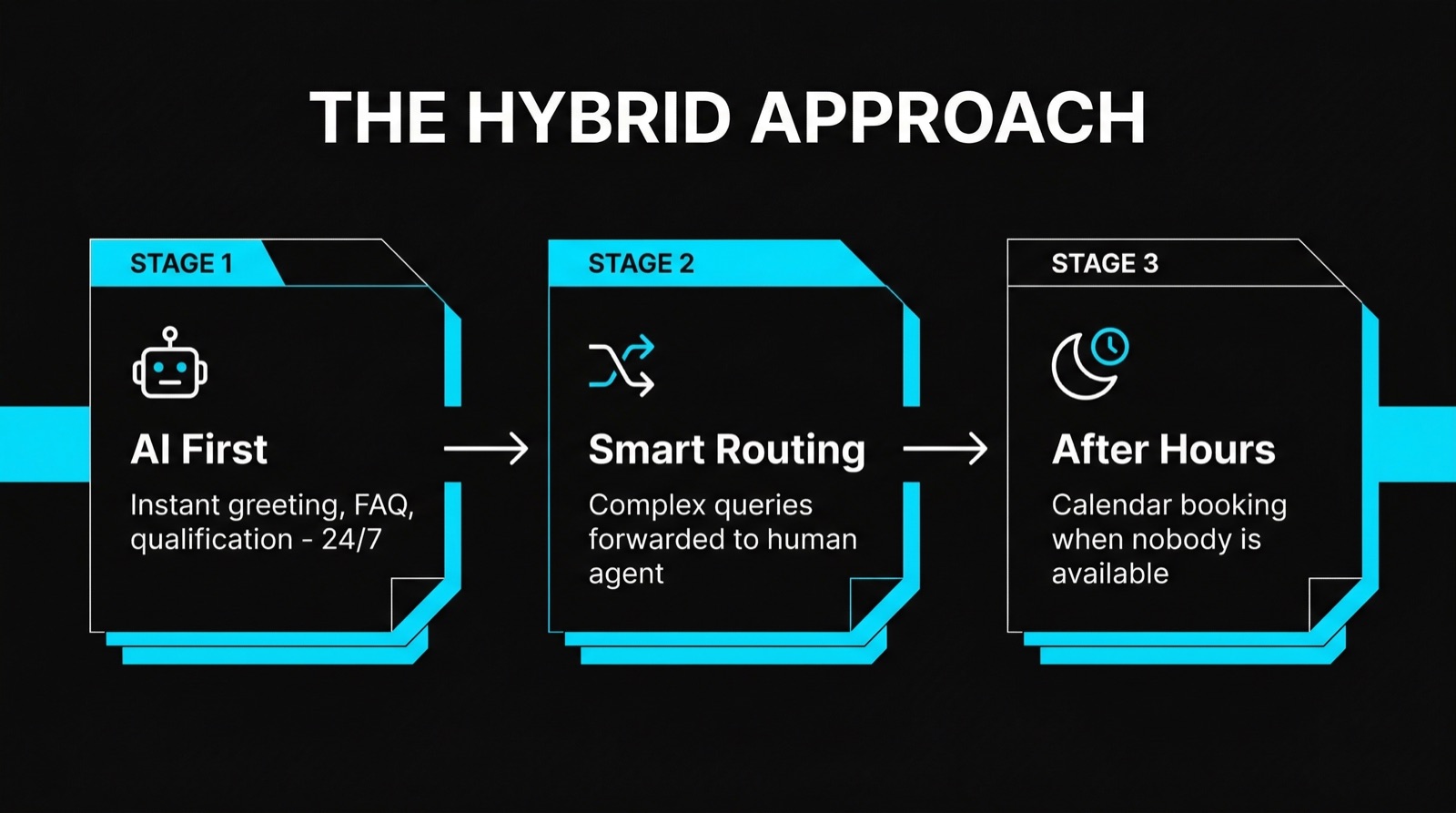
The structure looks like this:
- AI chatbot handles first contact. Every visitor gets engaged instantly, regardless of time or day. The chatbot asks qualifying questions, answers common queries, and determines intent.
- Qualified high-value leads get routed to a human. When the chatbot identifies a prospect with a deal size above a certain threshold or a question that requires nuance, it hands off the conversation to a live agent with full context.
- After hours, the chatbot books meetings. When no agents are available, the chatbot schedules qualified prospects directly into the sales team's calendar for the next business day.
This hybrid model captures the chatbot's speed and availability while preserving the human touch for complex, high-stakes conversations.
The handoff is the critical piece. A bad handoff (making the prospect repeat themselves, long wait for the agent, lost context) destroys the trust the chatbot built. A good handoff feels seamless: the agent greets the prospect by name, references what they discussed with the chatbot, and picks up exactly where the AI left off.
If you are considering this kind of setup, our AI automation service builds hybrid systems that integrate chatbot qualification with live agent routing and CRM synchronization. We have also outlined the most important use cases in our article AI for SMEs: 5 Practical Use Cases.
When Live Chat Still Wins
There are B2B scenarios where live chat is the better primary channel:
- Enterprise sales with deal sizes above 100,000 EUR. When a single deal funds your quarter, the personal touch of a human conversation justifies the cost. These prospects expect to talk to a person, not a bot.
- Highly technical products requiring demo-style conversations. If a prospect needs to describe a 40-step workflow to get an accurate answer, human agents handle the complexity better than current AI systems.
- Regulated industries with compliance requirements. Financial services, healthcare, and legal sectors sometimes require human oversight on every client interaction. Check your compliance obligations before deploying autonomous chatbots.
- Small visitor volumes under 500/month. If you get 15 visitors per day, a single agent can handle all conversations personally. The automation economics only kick in at scale.
The pattern: live chat wins when the value of a single conversation is extremely high and the volume is low enough for humans to manage.
What Changes When You Add AI to the Mix
The gap between chatbots and live chat is not static. It is closing in one direction.
In 2020, chatbots were keyword-matching systems that frustrated more visitors than they helped. In 2025, they handle multi-turn conversations, reference previous interactions, pull data from your CRM, and adapt their tone based on the prospect's behavior. The jump in capability over 5 years is significant.
Live chat, by contrast, faces structural constraints. You cannot make a human agent respond faster than 30 seconds. You cannot scale a team to cover 168 hours per week without significant cost. You cannot guarantee consistent qualification criteria across 5 different agents on 5 different days.
The trajectory favors AI. Not because humans are bad at conversations, but because the operational limitations of staffing a live chat team do not scale, and the capability of AI systems improves every year.
Key Takeaway
For most B2B companies, AI chatbots convert better than live chat. Not because the conversations are better, but because they happen more often, faster, and at a fraction of the cost. The 5-minute rule is not a suggestion. It is a conversion cliff. Every minute you make a prospect wait costs you qualified pipeline.
The winning strategy is not chatbot or live chat. It is chatbot first, human when it matters. Automate the 80% of conversations that follow predictable patterns. Reserve your team for the 20% that require judgment, empathy, and technical depth.
FAQ
Will prospects be annoyed by a chatbot instead of a real person?
The data says no, at least not if the chatbot is well-built. A 2024 Salesforce survey found that 69% of consumers prefer chatbots for quick answers and initial interactions. In B2B, acceptance is even higher when the alternative is a contact form with a 48-hour response time. What annoys prospects is not the technology. It is bad experiences: slow responses, irrelevant answers, and dead-end conversations. A well-trained chatbot that answers accurately and routes to a human when needed consistently outperforms a "Leave a message" widget in visitor satisfaction scores.
How accurate are AI chatbots at qualifying B2B leads?
Modern AI chatbots achieve 85-92% qualification accuracy when trained on clear criteria. This means that for every 100 leads the chatbot marks as qualified, 85-92 actually meet your ideal customer profile when reviewed by a human. For comparison, human agents typically qualify at 70-85% accuracy because of inconsistency between agents, rush decisions during busy periods, and subjective judgment calls. The chatbot applies the same rules every time. The key to high accuracy is specificity in your qualification criteria. Vague rules like "seems interested" produce vague results. Concrete rules like "company size above 50 employees, budget confirmed above 5,000 EUR, timeline under 3 months" give the AI clear thresholds to work with.
Can a chatbot handle multiple languages for international B2B companies?
Yes. Modern AI chatbots support 50+ languages and can switch languages mid-conversation based on the visitor's preference. For B2B companies operating across Europe, this is a significant advantage over live chat, where multilingual support means hiring agents for each language at 25,000 - 45,000 EUR per agent per year. A single AI chatbot handles German, English, French, and Spanish conversations simultaneously without additional cost. The quality of non-English conversations has improved substantially since 2023, with major language models now performing at near-native fluency in most European languages. For companies based in Germany serving international clients, this eliminates the need to choose between German-only support and the cost of a multilingual team.
Founder, Webkomodo
Ready for your project?
Let's find out how we can grow your business digitally in a free consultation.
Free consultation