What Is AI Lead Generation?
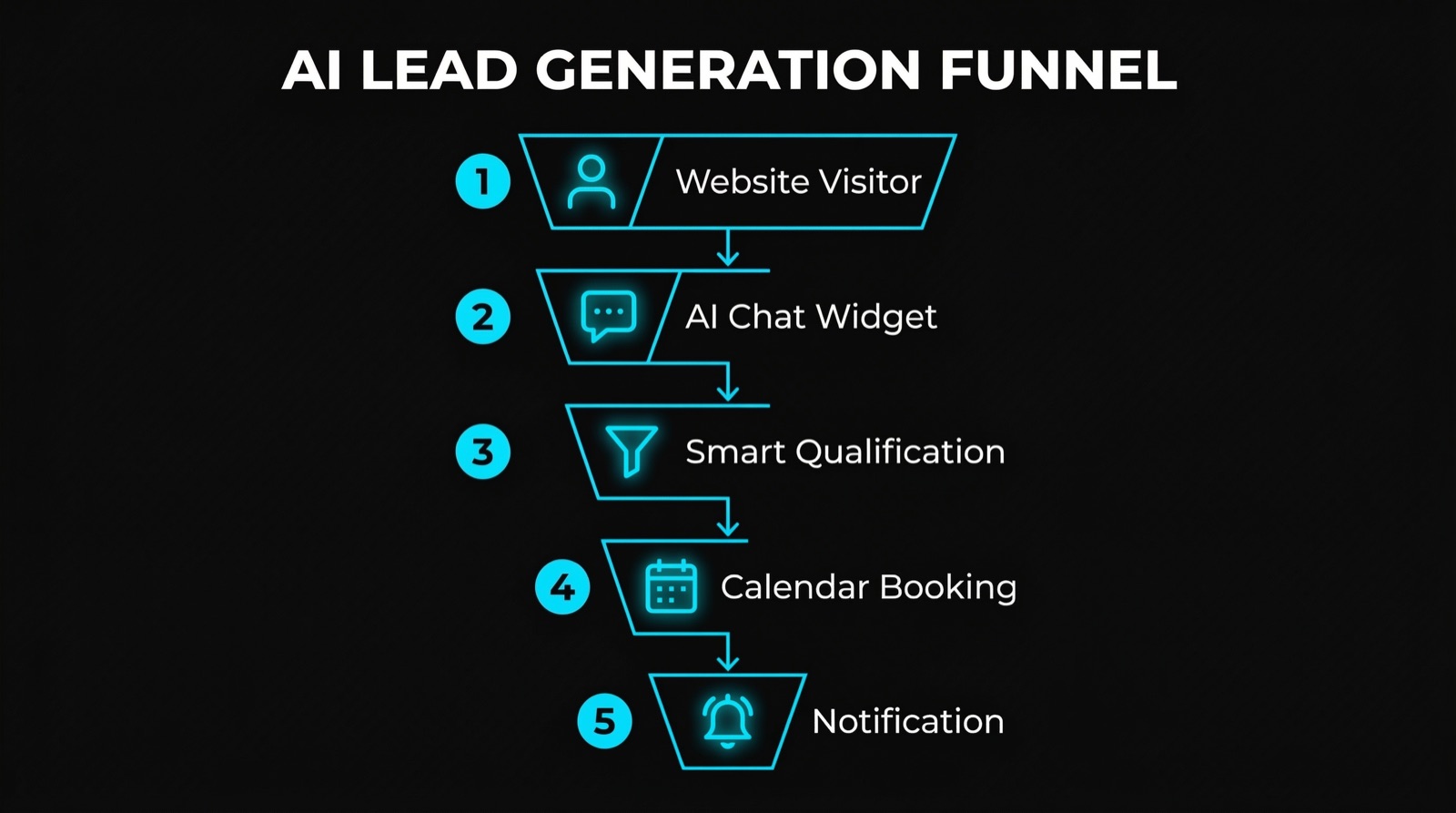
AI lead generation is the process of using trained software to identify, engage, and qualify potential customers without human intervention. Instead of waiting for a visitor to fill out a contact form and hoping someone follows up within 48 hours, AI systems engage prospects the moment they land on your site, ask qualifying questions, and book meetings directly into your sales team's calendar. For B2B companies, this means fewer missed opportunities and a pipeline that fills itself around the clock.
The technology behind it is not magic. It combines natural language processing, behavioral tracking, and CRM integrations to do what a great sales rep does, just faster, cheaper, and at 2 AM on a Sunday.
Why B2B Companies Need This Now
The average B2B website converts between 1% and 3% of visitors. That means 97 out of 100 people who find your site leave without ever talking to you. Most of them were qualified. They had the problem you solve. They just did not find a reason to stay.
Traditional lead generation relies on static forms, generic CTAs, and manual follow-up. According to a Harvard Business Review study, companies that respond to leads within 5 minutes are 100x more likely to connect and 21x more likely to qualify them compared to companies that wait 30 minutes. The problem: the average B2B response time is over 42 hours.
AI closes that gap to zero.
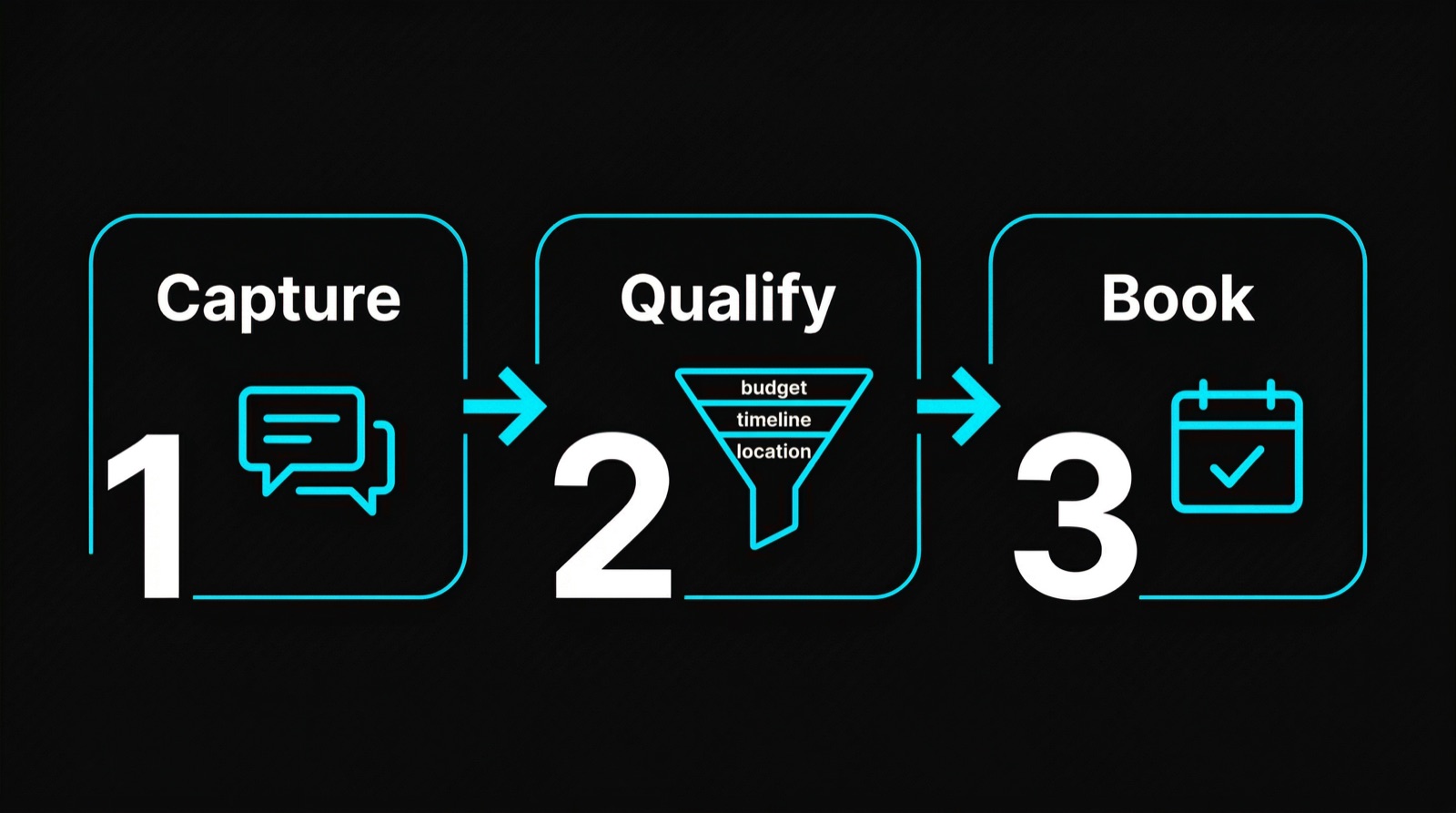
How AI Lead Generation Works: 3 Steps
Step 1: Identify and Engage
The system monitors visitor behavior in real time. Which pages they visit, how long they stay, where they scroll, and what they click. Based on this data, it decides when and how to engage.
A visitor reading your pricing page for the third time in a week gets a different message than someone who just arrived from a Google search. The AI tailors the conversation based on intent signals, not generic pop-ups that annoy everyone equally.
This is what separates AI engagement from the chat widgets of 2018. The system does not wait passively. It initiates conversations when the timing is right.
Step 2: Qualify Automatically
Once a conversation starts, the AI asks targeted questions to determine if the visitor matches your ideal customer profile. Industry, company size, budget, timeline, specific pain points. Every question is designed to filter out tire-kickers and surface high-value prospects.
The qualification criteria come from your sales team. You define what a good lead looks like, and the AI applies those rules consistently across every single conversation. No shortcuts, no bad days, no forgotten follow-ups.
Qualified leads get routed instantly. Unqualified visitors get helpful resources instead of a dead end. Both outcomes are better than a form submission sitting in an inbox.
Step 3: Book and Hand Off
When a visitor qualifies, the AI books a meeting directly. It checks your team's calendar availability, suggests time slots, confirms the appointment, and sends reminders. By the time your sales rep opens their laptop, the meeting is on the calendar with full context: what the prospect asked, what they care about, and where they are in the buying process.
This handoff is where most traditional systems fail. Even companies with live chat lose deals in the gap between "interested" and "scheduled." AI eliminates that gap entirely.
If you want to see this in action, our AI leads system shows exactly how the qualification-to-booking pipeline works for B2B companies.
Traditional Lead Generation vs AI Lead Generation
| Factor | Traditional | AI-Powered |
|---|---|---|
| Response time | 42 hours average | Under 5 seconds |
| Availability | Business hours only | 24/7/365 |
| Lead qualification | Manual, inconsistent | Automated, rule-based |
| Cost per qualified lead | $150-$500 | $30-$80 |
| Follow-up rate | 27% of leads never contacted | 100% engagement |
| Personalization | Template-based | Behavior-based, real-time |
| Scalability | Hire more reps | Same system handles 10x volume |
| Data capture | Form fields only | Full conversation + behavior data |
The numbers tell a clear story. Traditional methods are not just slower. They are structurally incapable of competing with systems that operate in real time.
The ROI of AI Lead Generation
Let's run the math on a real scenario.
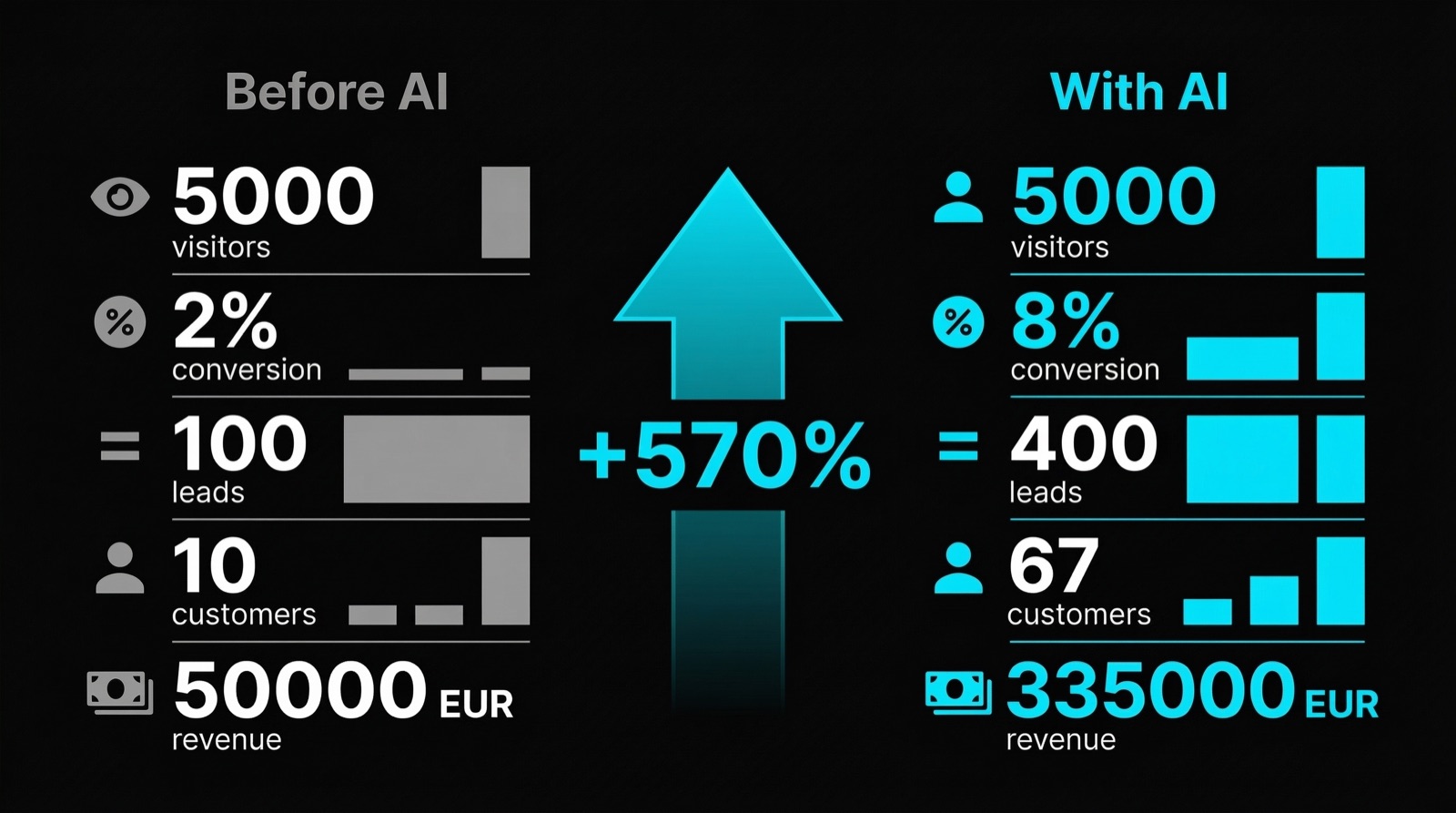
A B2B company gets 5,000 monthly website visitors. With a traditional form-based approach converting at 2%, that is 100 leads per month. After qualification (generous 30% rate), you have 30 qualified leads. Close rate of 10% gives you 3 new customers.
Now add AI lead generation. The same 5,000 visitors, but the engagement rate jumps to 8-12% because the AI proactively starts conversations. Call it 10%, so 500 engaged visitors. Automated qualification at a 40% rate (higher because the AI pre-filters before qualifying) produces 200 qualified leads. Same 10% close rate: 20 new customers.
That is a 6.7x increase in customers from the same traffic.
The cost side is equally compelling. A dedicated SDR in Germany costs between 45,000 and 65,000 EUR per year in salary alone, before tools, training, and management overhead. An AI lead generation system runs at a fraction of that and handles unlimited concurrent conversations.
For companies spending 5,000 to 15,000 EUR per month on paid ads, improving conversion by even 3 percentage points can mean the difference between burning budget and building pipeline.
When to Use AI Lead Generation
AI lead generation works best for B2B companies that meet these criteria:
- Average deal value above 2,000 EUR. The automation investment needs to pay for itself. Low-ticket products rarely justify the setup.
- Sales cycle longer than 2 weeks. If people buy on impulse, you need a different approach. AI shines when prospects need nurturing and qualification.
- Website traffic above 1,000 monthly visitors. The system needs enough data to work with. Below that threshold, focus on driving traffic first.
- Defined ideal customer profile. If you cannot describe your best customer in 5 sentences, the AI cannot qualify for you. Garbage in, garbage out.
- Existing sales process. AI amplifies what works. If your offer, pricing, and close process are broken, automation will just surface those problems faster.
Companies in professional services, SaaS, manufacturing, and consulting see the strongest results. The common thread: high-value deals where every qualified conversation matters.
What AI Lead Generation Does Not Do
Let's be honest about limitations.
AI does not replace your sales team. It replaces the repetitive parts of their job: initial engagement, basic qualification, scheduling. Your closers still close. Your strategists still strategize. The AI just makes sure they spend their time on prospects who are ready to buy.
It also does not work without maintenance. Your qualification criteria will change. Your messaging will evolve. The AI needs regular updates to stay effective, just like any other sales tool.
And it does not fix bad offers. If your product does not solve a real problem at a fair price, no amount of automation will save you. The AI will just tell you faster that nobody is buying.
How to Get Started
The implementation path for most B2B companies looks like this:
- Audit your current conversion funnel. Where are visitors dropping off? What is your form conversion rate? How fast does your team respond to inquiries?
- Define qualification criteria. Work with your sales team to establish the 4-6 questions that separate good leads from bad ones.
- Choose the right system. Not every AI tool is the same. Look for systems that integrate with your CRM, support your language, and allow custom training on your specific use case.
- Launch, measure, iterate. Start with one high-traffic page. Measure engagement rate, qualification rate, and booked meetings. Optimize weekly for the first month, then monthly.
If you want a system built specifically for B2B lead qualification and booking, check out how we build AI automation pipelines that connect directly to your CRM and calendar.
Key Takeaway
AI lead generation is not a trend. It is a structural shift in how B2B companies build pipeline. The companies adopting it now are not just saving money on SDR salaries. They are capturing demand that their competitors let walk away every day.
The question is not whether AI will handle your lead generation. It is whether you will be the company using it or the company losing deals to someone who does.
FAQ
How much does AI lead generation cost compared to hiring an SDR?
A full-time SDR in Germany costs 45,000 to 65,000 EUR per year in salary, plus 15,000 to 25,000 EUR in tools, training, and overhead. Total: 60,000 to 90,000 EUR per year for one person who works 8 hours a day, 5 days a week. AI lead generation systems typically run between 500 and 2,000 EUR per month (6,000 to 24,000 EUR per year) and operate around the clock. For most B2B companies, the AI handles 3-5x the conversation volume at 20-30% of the cost. The SDR role does not disappear. It shifts to higher-value activities like demos, proposals, and closing.
Can AI lead generation work for companies with complex products?
Yes, and complex products are actually where AI performs best. The longer and more technical the sales cycle, the more qualifying questions need to be asked before a sales rep should get involved. AI systems can be trained on technical documentation, product specs, pricing models, and common objections. They handle the first 70-80% of the conversation (gathering requirements, answering standard questions, confirming fit) and hand off to a specialist with full context. Companies selling enterprise software, industrial equipment, and professional services consistently see the highest ROI from AI qualification.
How long does it take to see results from AI lead generation?
Most companies see measurable results within 2-4 weeks of launch. The first week is calibration: the AI engages visitors, you review the conversations, and you adjust qualification criteria. By week 2-3, the system is booking qualified meetings consistently. Full optimization typically takes 6-8 weeks, as you refine messaging based on real conversation data. The key variable is traffic volume. Companies with 5,000+ monthly visitors reach statistical significance faster and can optimize more aggressively. Companies with lower traffic should expect a longer ramp-up period but will still see improvement over traditional forms within the first month.
Founder, Webkomodo
Ready for your project?
Let's find out how we can grow your business digitally in a free consultation.
Free consultation