A founder posts on LinkedIn: "I built my entire website in 5 minutes with AI. Agencies are dead." 4,000 likes. 200 comments. Everyone nods.
Six weeks later: 12,000 visitors, 3 inquiries. Conversion rate: 0.025%.
This isn't an outlier. It's the pattern. And the reason has nothing to do with technology. It's psychology.
The 5-Minute Website Trap
AI website builders like v0, Bolt, and Cursor are impressive. They generate clean code, responsive layouts, and even animated components. In 5 minutes, you have a website that looks good.
The problem: "Looking good" and "selling" are two entirely different things.
A study by the Stanford Web Credibility Research Group found that 75% of users judge a company's credibility based on website design. Not content. Not testimonials. Design.
But "design" here doesn't mean colors and fonts. It means: How does the page feel in the first 50 milliseconds? How much mental energy does it take to find the next action? How rewarding does each interaction feel?
These are psychological mechanisms. And AI doesn't understand any of them.
The 3 Invisible Layers AI Can't Replicate
1. The Halo Effect: The First 50 Milliseconds Decide Everything
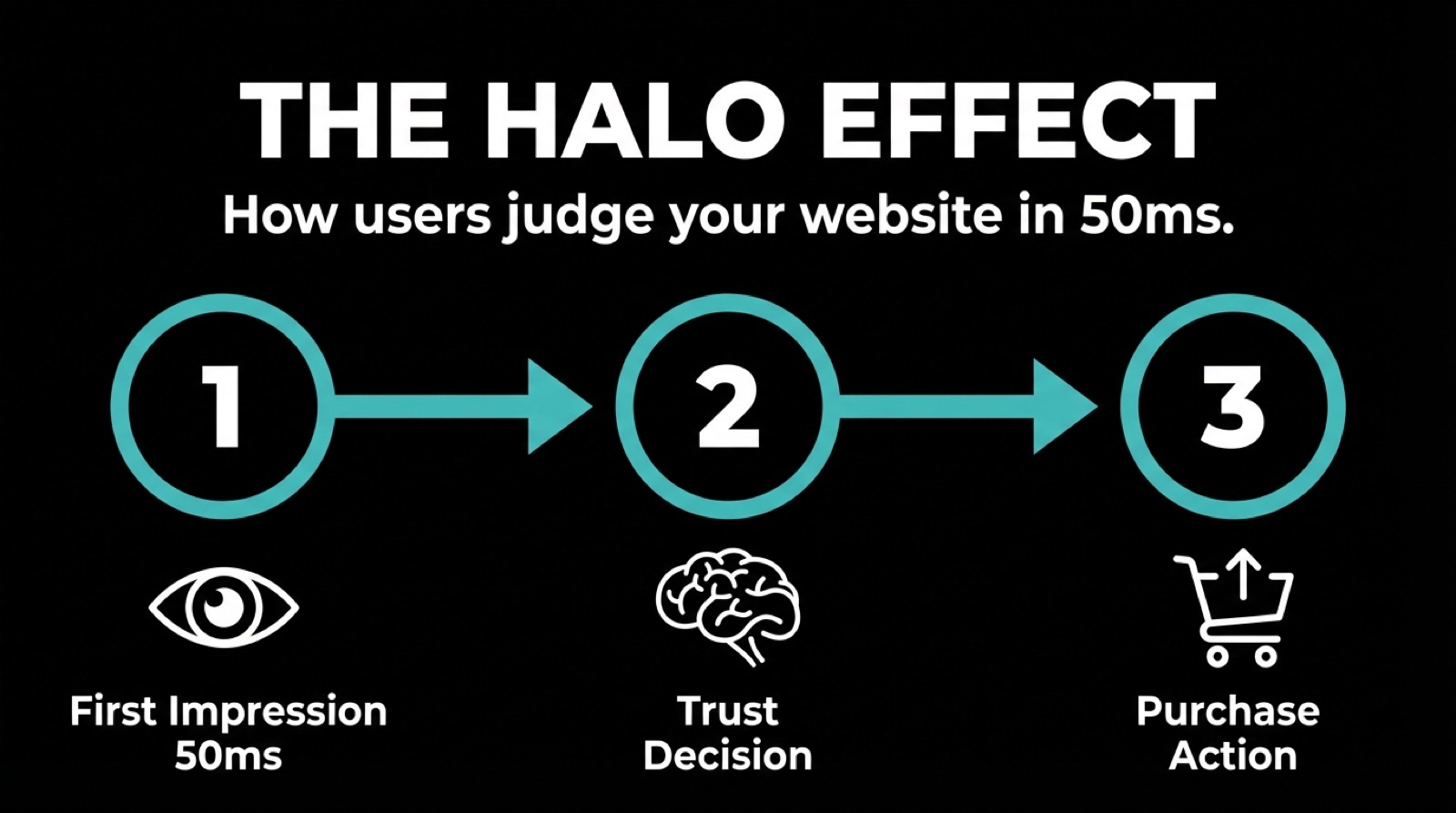
The Halo Effect is a cognitive bias from social psychology: a single positive first impression colors the entire perception. Google confirmed this in a study: users form a judgment about a website within 50ms. That judgment influences whether they trust the company, read the content, and ultimately buy.
What does this mean in practice?
- Hero section = most valuable real estate. One clear emotion, not three messages at once.
- Visual quality signals business quality. If the website looks cheap, the company looks cheap.
- One CTA, not five. Every additional option reduces the likelihood of action by 23% (Hick's Law).
AI-generated websites fail here systematically. They produce generic hero sections with stock photos, three equal-weight buttons, and layouts that "work" but create no feeling. AI optimizes for completeness, not emotion.
Example: A typical AI-generated SaaS landing page has: logo, menu with 6 items, headline, subheadline, two buttons ("Book a Demo" and "Learn More"), a feature grid, testimonials. Everything's there. Everything's correct. And yet it feels like every other SaaS page. No Halo Effect. No "Wow, they're different."
2. Cognitive Load: Why Simple = Expensive
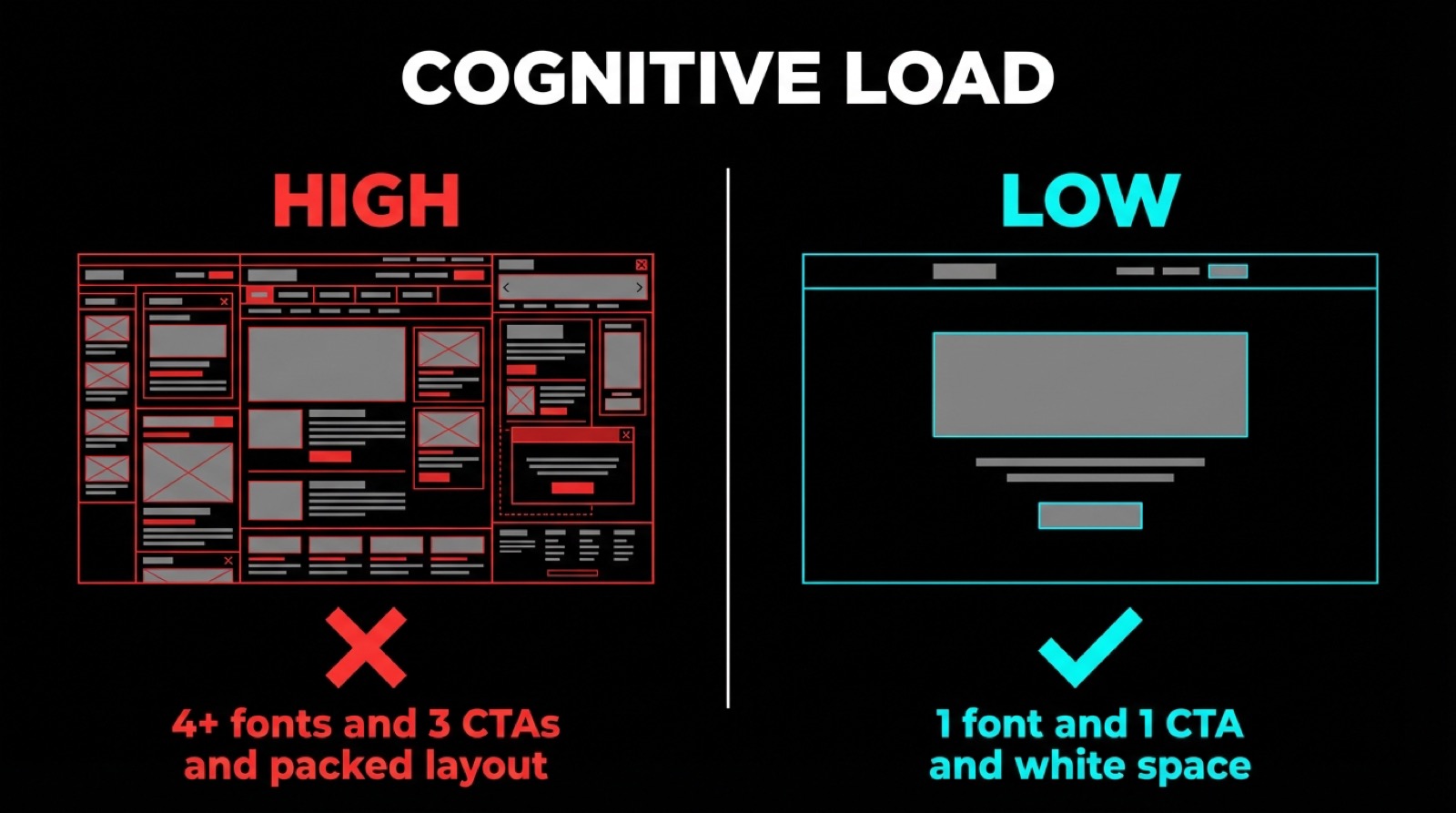
Cognitive Load describes the mental energy a user needs to process information. Research by Daniel Kahneman (Nobel Prize, 2002) shows: what's easy to process is perceived as true, trustworthy, and valuable.
This explains why premium brands use so much white space. It's not wasted space. It's a psychological signal: "We don't need to bombard you with information."
The principles:
| High Cognitive Load (= cheap) | Low Cognitive Load (= premium) |
|---|---|
| Packed layouts | Generous white space |
| 4+ typefaces | 1-2 fonts, clear hierarchy |
| Everything visible at once | Choreographed scroll reveals |
| Every section has 3 CTAs | One goal per section |
AI builders pack in everything that's "best practice." More sections, more features, more text. The result: high Cognitive Load. The website doesn't feel premium. It feels assembled.
The math: A website with low Cognitive Load converts up to 2x better than one with high Cognitive Load, according to a study by Google and the University of Basel. Not because it delivers more information, but because the brain needs less energy to say "Yes."
3. Micro-Interactions: The Peak-End Effect
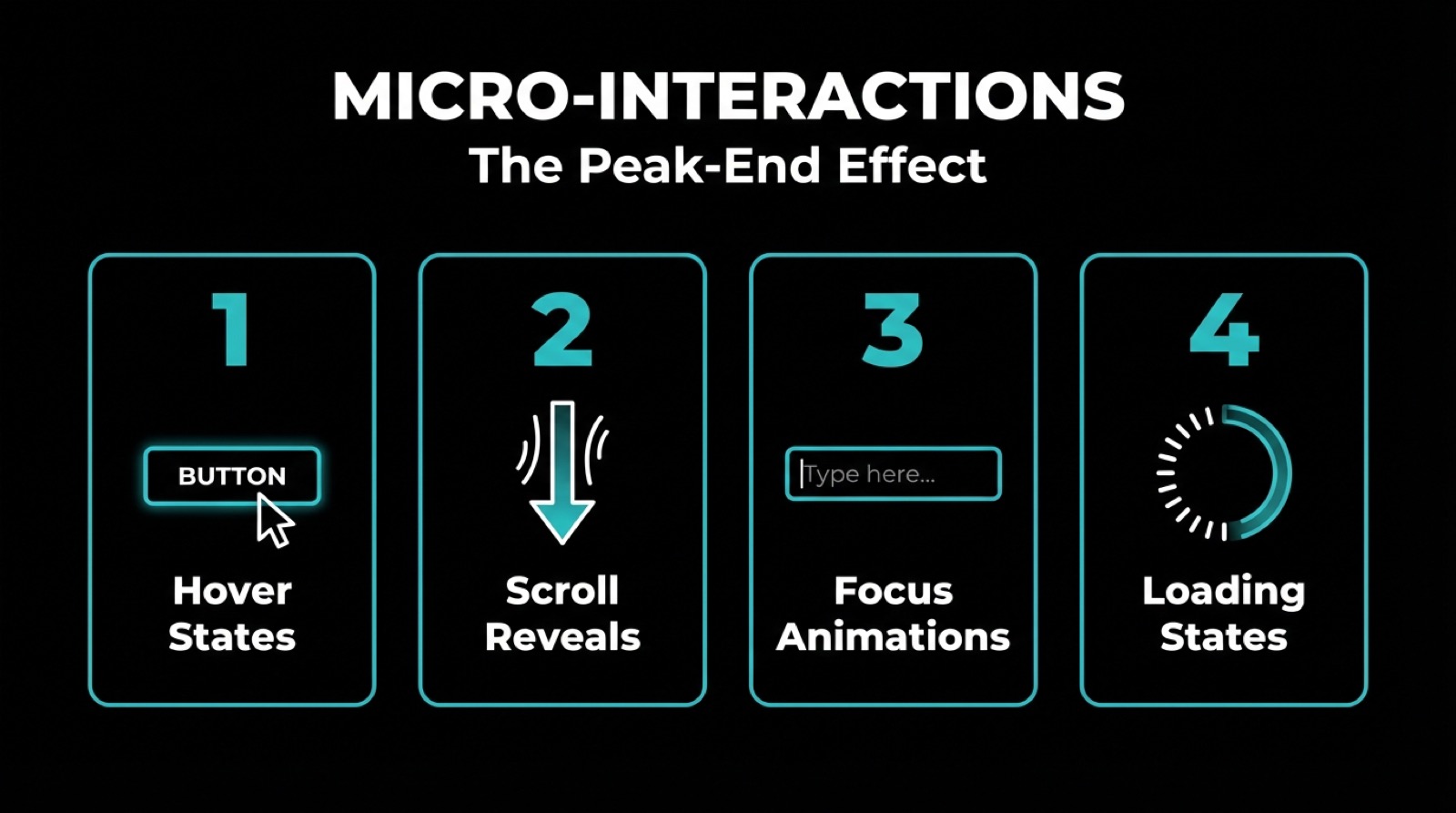
The Peak-End Effect (Kahneman, 1993) states: people remember experiences not by their average, but by the most intense moment (Peak) and the last moment (End).
Applied to websites:
- Peak: A particularly impressive hover effect, an elegant scroll animation, a "wow" moment.
- End: How does the final step feel? The confirmation page after the form? The animation on submit?
Micro-interactions are the invisible details that make the difference:
- A button that subtly grows and casts a shadow on hover
- Elements that fade in on scroll rather than just appearing
- Form fields with elegant focus animations
- Loading animations instead of blank screens
AI builders generate functional websites. Buttons work. Links work. But there are no choreographed moments, no peaks. It's like a restaurant where the food is fine, the service is correct, but you have nothing to tell anyone afterward.
The Numbers: AI-Generated vs. Psychology-Driven
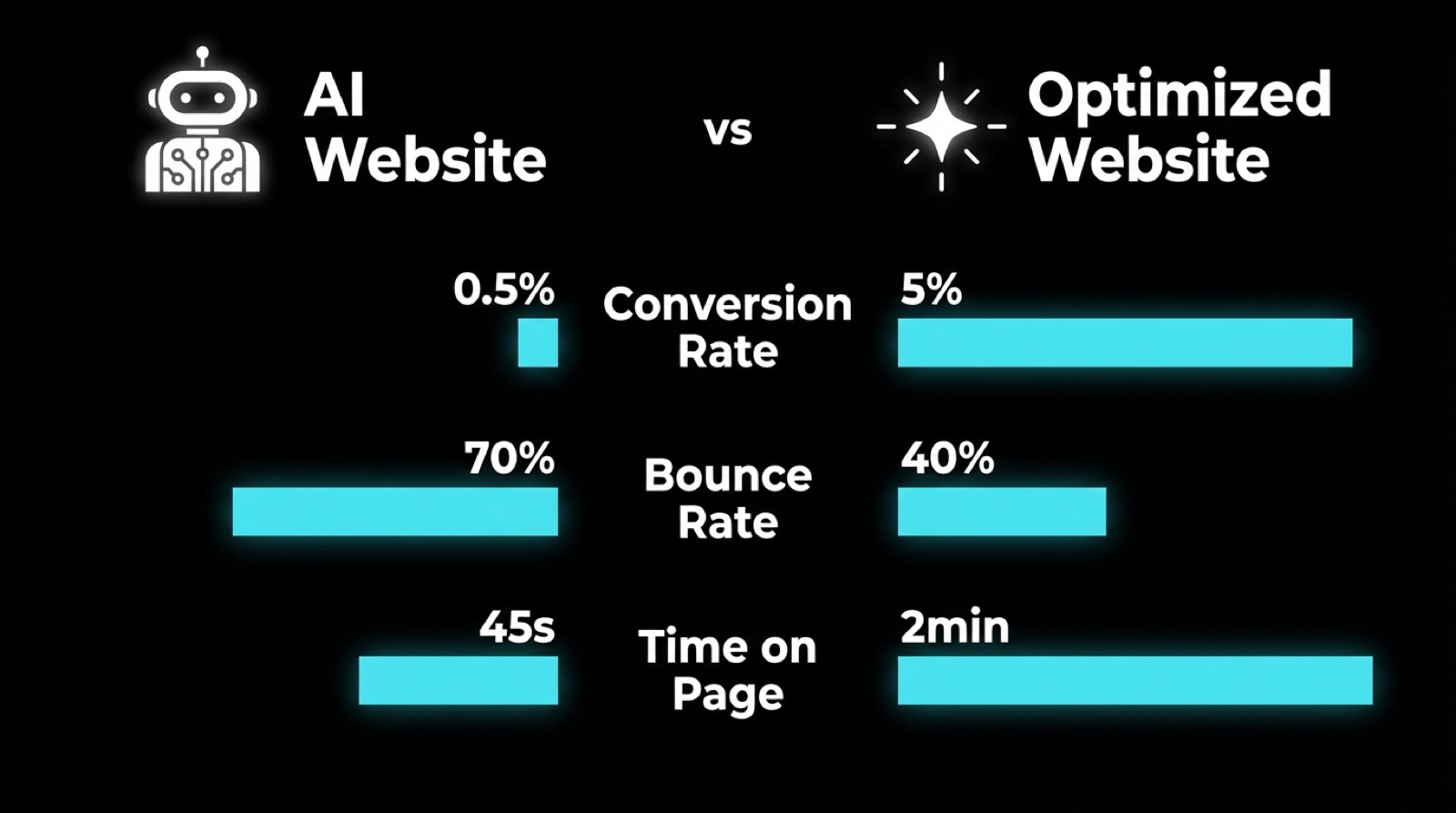
| Metric | Typical AI Website | Psychologically Optimized Website |
|---|---|---|
| Time on Page | 45 seconds | 2+ minutes |
| Bounce Rate | 65-75% | 35-45% |
| Conversion Rate | 0.5-1.5% | 3-7% |
| Returning Visitors | 8% | 22% |
The difference isn't marginal. It's the difference between a website as a cost center and a website as a revenue channel.
When AI Tools Are Still Useful
This article isn't an anti-AI stance. At Webkomodo, we use AI daily:
- Prototyping: First layout variants in minutes instead of hours
- Code generation: Boilerplate code that adds no value manually
- Content drafts: First text drafts that get human refinement
- Testing: Automated accessibility and performance checks
AI is an excellent tool. But a tool without strategy produces generic results. A hammer doesn't build a house. An architect with a hammer does.
The Hybrid Approach: AI + Psychology
The best website doesn't come from choosing between AI and manual work. It comes from combining them:
- Strategy (Human): Define target audience, positioning, desired emotion
- Prototyping (AI): Generate rapid layout variants
- Psychological Optimization (Human): Build in Halo Effect, Cognitive Load reduction, Micro-Interactions
- Development (AI + Human): AI for boilerplate, humans for the details that sell
- Testing (AI + Human): Data-driven A/B tests, human UX analysis
The result: a website that's done in weeks, not months, that looks modern, and that actually turns visitors into customers.
If you'd like to see how this approach could work for your business, take a look at our web design services or our pricing.
Key Takeaway
AI website builders are impressively fast. But speed isn't a business model. A website built in 5 minutes that doesn't convert is more expensive than a website built in 5 weeks that generates leads every month.
The three psychological layers (Halo Effect, Cognitive Load, Micro-Interactions) are why some websites sell and others just exist. AI can write code. But it can't build trust. Not yet.
FAQ
Will AI eventually build websites that convert just as well?
Possibly. But as of 2026, AI models lack understanding of industry-specific buying psychology. They optimize for general best practices, not the specific emotion that drives your target audience to act. Once AI can analyze real user behavior in real-time and respond to it, that will change.
Is an expensive website automatically better than an AI-generated one?
No. Price alone guarantees nothing. What matters is whether psychological principles (Halo Effect, Cognitive Load, Micro-Interactions) are deliberately applied. A low-cost website with clear psychology beats an expensive website without strategy.
What does a psychologically optimized website cost compared to AI?
An AI website builder is free or costs under $50/month. A professionally optimized website starts at $2,000 to $5,000. The difference: the AI website costs you more long-term because every non-converting visitor is lost revenue. With 10,000 visitors per month and a 2% conversion gap, that's 200 lost leads per month.
Founder, Webkomodo
Ready for your project?
Let's find out how we can grow your business digitally in a free consultation.
Free consultation